
Amanita Muscaria Microdosing: Restoration, Sleep & Returning to Yourself
Sep 21, 2026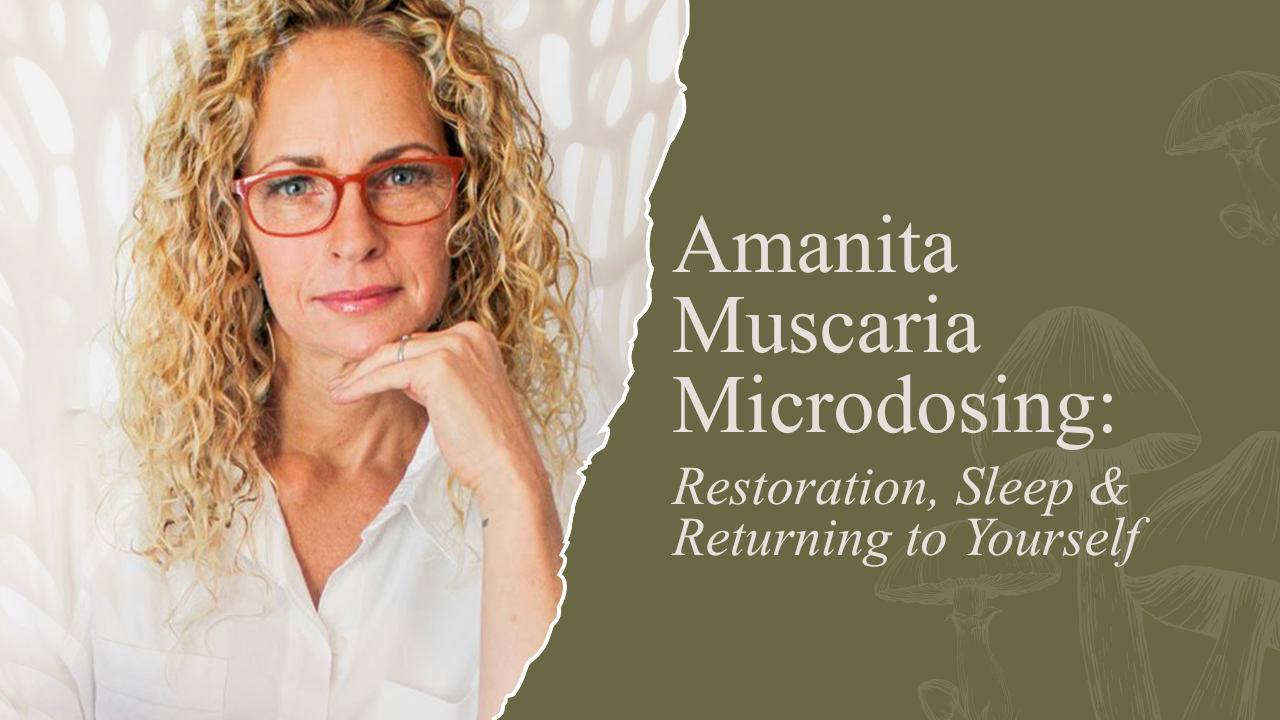
Amanita Muscaria Microdosing: What If Healing Felt More Like Returning?
There is a version of healing we have become very familiar with.
The breakthrough.
The release.
The moment everything suddenly makes sense.
We look for the big experience because big experiences are easy to recognize.
But sometimes the deepest shift is much quieter.
You sleep through the night.
Something that would normally send your nervous system into overdrive doesn’t affect you in quite the same way.
You pause before reacting.
You spend a weekend with family and realize afterward that you moved through it with more ease than usual.
Nothing dramatic happened.
And somehow, that is exactly the point.
In this episode of the Sacred Mycelium Podcast, Victoria sits down with Lynda Samphire, an intuitive and transformational guide whose work brings together nervous-system intelligence, dreams, contemplative practice, nature, and earth-based medicines.
Lynda is particularly known for her thoughtful work with Amanita muscaria and intentional low-dose psychedelic practices, as well as her exploration of dream and night consciousness. She is also the founder of SoulRoot, an educational community centered around this work.
Together, Victoria and Lynda explore a different relationship with plant medicine. One that is less focused on escaping the human experience and more interested in helping us feel safe enough to actually live inside it.
What Is Amanita Muscaria?
You probably already recognize Amanita muscaria, even if you don’t recognize the name.
It is the iconic red mushroom with white spots found throughout folklore, fairy tales, art, and forest imagery.
But Lynda speaks about Amanita in another way.
She describes her as an elder of the forest.
Unlike cultivated mushrooms that can be grown independently under controlled conditions, Amanita muscaria forms relationships with the root systems of certain trees. Its life is intertwined with the ecosystem surrounding it.
And that relationship becomes an important metaphor throughout this conversation.
Nothing exists entirely on its own.
Our sleep affects our stress.
Our stress affects our reactivity.
Our nervous system influences how much we can receive, process, feel, create, and connect.
The visible experience is only one part of a much larger system underneath.
Amanita Muscaria and the Nervous System: A Different Conversation Than Psilocybin
One of the most important distinctions Lynda and Victoria make is that Amanita muscaria and psilocybin are not interchangeable.
They contain different active compounds and interact with the brain through different pathways.
Psilocybin primarily acts through serotonin receptors, particularly 5-HT2A receptors.
Amanita muscaria contains compounds including muscimol and ibotenic acid. Muscimol interacts with GABA-A receptors, part of the brain’s inhibitory signalling system.
Lynda describes this through the metaphor of a gas pedal and a brake.
When someone has spent years in stress, hypervigilance, or constant “go mode,” life can begin to feel like the gas pedal is permanently pressed down.
Everything becomes harder to soften around.
Sleep.
Focus.
Emotional reactions.
The ability to simply stop.
This is where Lynda’s work with Amanita focuses heavily on restoration rather than stimulation.
In her experience guiding people with the mushroom, she is looking for the subtle moments where the system appears to have more room to move between activation and rest.
Not numbness.
Not disconnection.
More range.
What Happens When the Body Finally Feels Safe Enough to Soften?
One of the most interesting ideas in the episode is that insight alone may not be enough.
You can understand your patterns perfectly and still have a body that does not feel safe enough to let them go.
Victoria and Lynda talk about people whose nervous systems feel as though they are running at “5,000 RPM.”
The person may desperately want to surrender.
Their body is saying otherwise.
And this changes the way we think about healing.
Because sometimes what looks like resistance may actually be protection.
Sometimes the body needs a foundation before it needs another door opened.
Lynda describes Amanita as helping to “till the field,” while psilocybin may open or aerate what is already there.
It is a useful way of understanding their approach: before asking the nervous system to explore more, perhaps the first question is whether it has enough capacity to receive what emerges.
The Shifts You Almost Miss
Microdosing conversations can become very focused on one question:
Is it working?
We expect to feel something identifiable.
We expect a moment that proves something has changed.
But Lynda describes many of the changes she notices with people as almost deceptively ordinary.
Someone realizes they didn’t react to something the way they normally would.
Driving onto a freeway feels less stressful.
A difficult family interaction passes without overwhelming them.
They sleep more deeply.
They feel more creative.
At first, those things can be easy to dismiss because they do not look like a breakthrough.
They look like life.
And maybe that is the more meaningful measure.
The question stops being, Did I have an extraordinary experience?
It becomes:
Is ordinary life becoming a little easier to inhabit?
Amanita Muscaria, Sleep, and Why the Night Matters
Sleep becomes one of the strongest themes in Victoria and Lynda’s conversation.
Lynda describes sleep as “the number one medicine.”
When we are chronically underslept, everything else has to work harder. Emotional regulation becomes more difficult. Stress feels louder. The body has less opportunity to recover.
For Lynda, this is also where Amanita connects with another major part of her work: dreams and what she calls night intelligence.
She describes noticing that when people experience deeper or more sustained sleep, they may also begin remembering more of what is happening in their dreams.
That does not mean Amanita automatically creates lucid dreams or extraordinary nighttime experiences.
Rather, Lynda views it as potentially creating conditions in which someone becomes more receptive to what is already taking place during sleep.
And that distinction matters.
Her work is less interested in forcing an experience and more interested in learning how to pay attention.
Dreams, Liminal Spaces, and Learning to Receive
There is a strange place between sleeping and waking where the rational mind has not completely returned.
Images may still feel vivid.
A sentence may appear fully formed.
A dream may feel close enough to touch.
These threshold states are often referred to as hypnagogic states when entering sleep and hypnopompic states when waking.
For Lynda, they are not simply interesting neurological moments.
They are places where people can become curious about what their inner world is communicating.
In the episode, she shares how her own dream life and nighttime experiences deepened alongside her work with Amanita. She describes symbols, messages, vivid dreams, and the experience of waking while still feeling partially inside the dream.
Her interpretation of those experiences is deeply personal and spiritual.
But underneath it is a grounded invitation that does not require anyone else to interpret dreams in exactly the same way:
Pay attention to what becomes available when you are no longer gripping so tightly.
Sometimes receiving begins when the nervous system no longer feels responsible for controlling every moment.
Healing Does Not Mean Escaping the Human Experience
This may be the most important part of the conversation.
Plant medicine can easily become another way of chasing transcendence.
One more breakthrough.
One more mystical experience.
One more version of ourselves we believe we need to reach.
Lynda offers a different idea.
Expanded consciousness, she says, is not about transcending our humanity.
It is about becoming capable of being with more of it.
Love.
Grief.
Joy.
Anger.
Loss.
Change.
The uncomfortable parts do not disappear.
Instead, the hope is that we develop enough capacity to move through them without abandoning ourselves.
That is a significant shift.
Healing stops meaning I never want to feel this again.
It becomes Can I remain with myself while this moves through me?
Why Integration Still Matters When the Changes Are Subtle
Integration is easy to understand after a dramatic psychedelic experience.
Something significant happened, so naturally we need time to understand it.
But what about when the shifts are barely perceptible?
Lynda believes witnessing is particularly important here.
Someone may say nothing is happening and then, in conversation, begin listing things that are different.
They slept through the night.
They handled stress differently.
Their creativity came back.
They recovered from an emotional moment faster.
The role of integration becomes noticing.
A guide, community, journal, or reflective practice can help someone recognize patterns they might otherwise overlook.
Because sometimes transformation does not arrive announcing itself.
Sometimes it appears in retrospect.
Less Can Become More
There is a moment in the episode when Lynda talks about her personal relationship with Amanita changing over time.
Rather than describing a desire for more, she describes needing less.
That idea runs against a culture built around escalation.
More productivity.
More stimulation.
More transformation.
More medicine.
More healing.
But restoration may move in the opposite direction.
The goal is not necessarily to build an ongoing dependence on an experience.
It is to notice whether the practices we choose are helping us build a relationship with ourselves that exists beyond them.
That is why Victoria and Lynda keep returning to words like remembrance, restoration, and return.
Amanita Muscaria Safety and Sourcing Matter
Amanita muscaria deserves particular caution because conversations online can easily flatten a complicated subject.
It should not be confused with other species within the Amanita genus, some of which can cause severe or fatal poisoning.
Amanita muscaria itself contains biologically active compounds including ibotenic acid and muscimol, and ingestion can cause adverse effects. Preparation can substantially change the relative concentrations of these compounds, but it does not make self-directed use automatically safe.
In the episode, Lynda repeatedly emphasizes sourcing and preparation, including knowing exactly which species and preparation someone is working with.
That is one place where curiosity needs to remain connected to responsibility.
Online anecdotes, mushroom identification by appearance alone, or a product being readily available are not substitutes for qualified guidance or individualized medical advice—particularly for anyone who takes medications, has underlying health conditions, is pregnant or breastfeeding, or has a history of severe psychiatric symptoms.
Returning to Yourself May Feel Uncomfortable
Near the end of their conversation, Victoria asks Lynda a deceptively simple question:
What does returning to yourself actually feel like?
Lynda’s answer is not that it feels immediately peaceful.
She says it can be uncomfortable.
We become accustomed to outsourcing ourselves.
Looking elsewhere for certainty.
Approval.
Direction.
Permission.
So returning to yourself requires rebuilding something that may have become unfamiliar: trust.
Trusting what you feel.
Learning how to receive.
Allowing yourself to move between expansion and contraction without deciding one is success and the other is failure.
It is less like arriving at a final destination and more like developing a relationship.
And like any meaningful relationship, that takes time.
The Key Takeaway
The most compelling thing about this conversation is that Amanita muscaria is almost not the whole point.
The deeper conversation is about capacity.
Can your nervous system experience activation and still find its way back?
Can you notice what your dreams, emotions, and body are communicating without immediately trying to fix them?
Can you experience grief without believing you have failed at healing?
Can you experience joy without needing to hold onto it forever?
Can you trust yourself enough to remain present through both?
Plant medicine may be one doorway people explore in that process.
But the destination Lynda and Victoria keep returning to is much simpler.
Not becoming someone else.
Not escaping into a higher version of yourself.
Coming home to the person who was already there.
About Guest Expert Lynda Samphire
Lynda Samphire is an intuitive and transformational guide whose work explores consciousness through relationship. Her approach weaves together nervous-system intelligence, dreamwork, contemplative practice, nature, and earth-based medicines.
She is known for her thoughtful approach to Amanita muscaria and intentional low-dose psychedelic work, with an emphasis on presence, creativity, connection, and bringing insight back into everyday life. Lynda is also the founder of SoulRoot, an educational community centered around this work.
Rather than focusing exclusively on extraordinary or peak experiences, much of Lynda’s work explores the quieter capacities that allow us to live more fully inside ordinary life.
Want to explore more of Lynda’s work?
Join Lynda’s newsletter and receive access to her free guides, The Healing Path of Amanita Muscaria and Work with Your Night.
Join Lynda’s Newsletter Here
GET THE FREE WORKSHOP
Trauma, the Body, and the Breath
A free on-demand workshop on releasing what the mind can’t, and how psilocybin supports healing through neuroscience, breathwork, and plant medicine
DON'T MISS WHAT'S NEXT
You don’t have to go looking for the next conversation. New episodes and reflections are shared as they unfold.
Stay connected as they’re released.
We hate SPAM. We will never sell your information, for any reason.