
The Room Looked the Same. So Why Did It Feel Like Someone Else Was Seeing?
Nov 02, 2026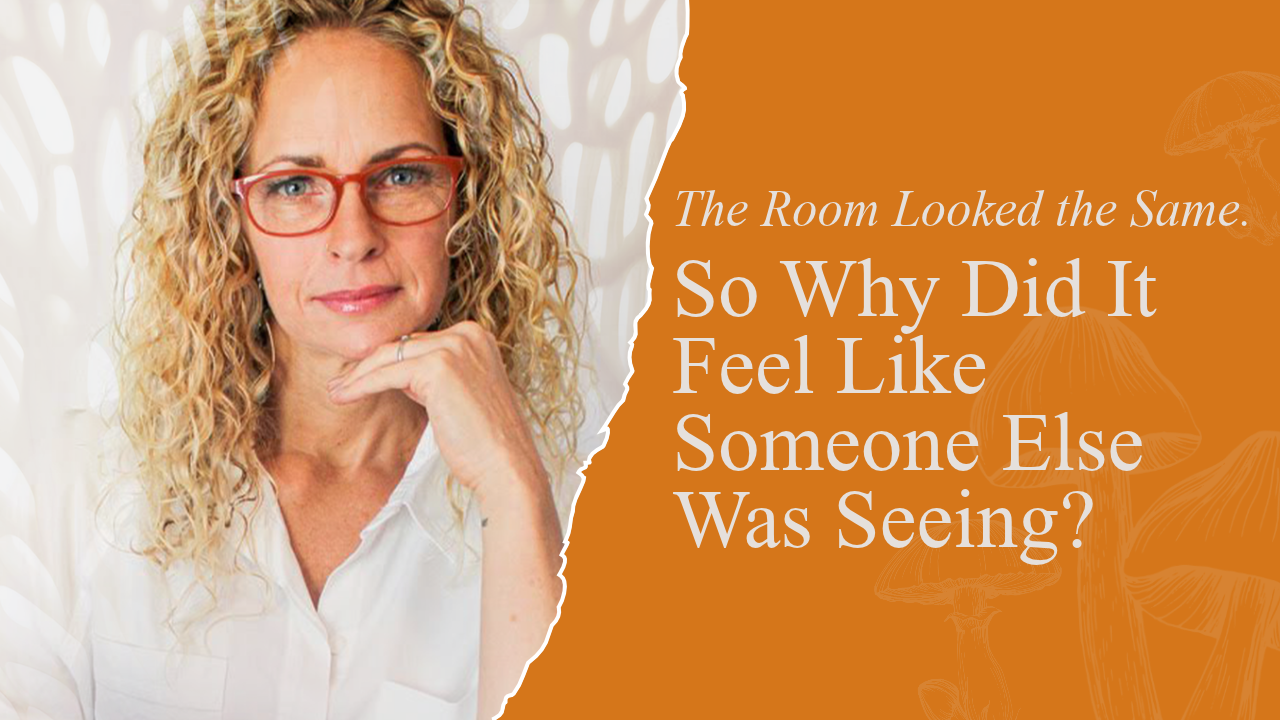
The bookshelf was still a bookshelf.
No melting wood. No faces appearing in the books. No obvious visual transformation that would explain why the room suddenly felt so strange.
Yet the person looking at it no longer felt like the familiar center of their own experience.
Their everyday identity seemed far away. The bookshelf, its objects, and the empty spaces between them appeared saturated with meaning. They could feel that significance without being able to explain it.
Then an interpretation arrived: this was the part of them that wakes when they go to sleep.
For them, that thought made the experience feel coherent.
It also made it frightening.
In Part 2 of Sacred Mycelium’s Jungian conversation, Victoria Lee Starr follows this new story into questions about dreams, symbols, selfhood, and how we make sense of experiences that seem more convincing than our usual explanations.
Where Part 1 Leaves Us
Part 1 explored a different person’s account of vivid inner voices, symbolic figures, and a confrontation with parts of themselves they had avoided.
They encountered Jung’s ideas afterward, through therapy. The vocabulary of shadow and archetypes seemed to describe a landscape they had already visited.
The most meaningful part of that story was what followed: curiosity, support, and recognizing patterns in sober life.
Part 2 does not pick up with the same person. It continues the inquiry through another account.
This time, the subject did not simply describe meeting a figure or recognizing an inner part. They felt immersed in another way of perceiving.
That difference gives the continuation its tension. What happens when the familiar observer—the “me” who seems to be looking—starts to feel unfamiliar?
An Ordinary Room With an Unordinary Meaning
The person described taking a very large amount of mushrooms alone in their bedroom. Previous experience with psychedelics did not prepare them for the particular strangeness of what followed.
Their room remained recognizable.
But familiar categories stopped feeling sufficient.
A shelf was no longer simply storage. The color of one object, the height of another, their positions and the gaps between them seemed connected by significance.
They were not describing an ordinary association such as a book reminding them of childhood. In the retelling, the meaning felt older, heavier, and less easily put into words.
That is the detail Victoria returns to: the appearance of the object and the experience of its meaning had come apart.
The shelf did not need to change shape for the person’s relationship to it to change completely.
When Your Usual Self Feels Far Away
The account becomes more unsettling when the person describes their own position inside the experience.
They compared it to being at the bottom of a well. Their ordinary awareness was present, but distant. They knew where they were, yet did not feel like the one doing the perceiving.
It seemed as though another awareness was looking through their eyes.
That is a report of how the experience felt. It does not establish that another consciousness was literally present.
Victoria’s response leaves room for both its emotional force and uncertainty about its explanation. Something can be deeply frightening without the first explanation that arrives being the only possible one.
The question “who is seeing?” can feel very different from “why does that object look strange?”
One concerns what is in the room. The other unsettles the familiar experience of being the person in it.
The Dream Interpretation
The person’s clearest interpretation connected the experience with sleep.
Perhaps, they thought, this was the part of them that becomes active when their waking identity recedes.
Victoria considers why the comparison would feel persuasive. Dreams can have a sense of significance that does not depend on ordinary explanation. A place may feel like a familiar home even when its layout is impossible. A figure may carry emotional importance before we understand why.
In the story, the person felt awake while caught inside a similarly symbolic experience.
That comparison can be useful without becoming a literal description of a separate being who takes over each night.
The distinction allows a question to stay open: what did the dream comparison help this person express about the experience?
Why Jung Enters the Conversation
Victoria uses Jung as a lens for thinking about symbols, images, and aspects of mental life that do not arrive in the clean language of conscious reasoning.
The connection is not that the story proves a Jungian theory.
It is that Jungian language gives the conversation somewhere to begin.
In Part 1, someone recognized a framework after encountering vivid inner figures. In Part 2, the framework helps Victoria ask what it might mean to feel immersed in symbolic perception itself.
There is a difference between using a map and deciding the map explains every feature of the landscape.
A useful framework can offer language, questions, and patterns. It does not need to settle what the experience ultimately was.
The Unconscious Is Not Necessarily a Destination
One of the episode’s strongest cautions concerns metaphor.
It is tempting to imagine the unconscious as a hidden room. Ordinary awareness lives upstairs; something vast waits below. An altered state becomes the staircase.
That image has emotional force. It can also make a metaphor feel like a physical discovery.
Victoria offers a quieter reading: perhaps processes normally outside awareness became unusually available to it.
The person’s experience of entering another world can be taken seriously as a description. We do not have to conclude that they located a literal place beneath their conscious mind.
This matters because a metaphor can help someone speak without needing to become a factual claim about the architecture of consciousness.
Meaning and Explanation Are Different Questions
The bookshelf seemed profoundly meaningful.
But the strength of that feeling did not tell the person exactly what the meaning was.
This is where the episode turns toward integration.
The raw experience included a familiar room, altered selfhood, and intense symbolic significance. The explanations came afterward—or alongside it: another awareness, the unconscious, the part that wakes during sleep.
Victoria invites curiosity about the distance between those things.
What happened?
What did it feel like?
What did I decide it meant?
What else might help me understand it?
Separating these questions does not require dismissing the experience. It gives the person more room to consider it without becoming trapped inside the first interpretation.
When Certainty Is Part of the Experience
Some unusual experiences arrive with an intense sense of knowing.
An idea does not feel tentative. It feels obvious, complete, and beyond argument.
Victoria treats that certainty as something worth noticing in its own right.
The feeling of knowing can be part of what happened. It does not automatically resolve whether the explanation is accurate.
That distinction can be uncomfortable. A person may worry that questioning an interpretation means betraying an experience that mattered to them.
The episode offers another possibility: an experience can remain meaningful while its interpretation changes.
You can remember the force of the moment and still ask what remains useful, coherent, or connected to life afterward.
Why the Fear Deserves Attention
The story includes confusion and very little sense of control.
It would be easy to become so fascinated by its symbolism that the person’s fear disappears from the retelling.
Victoria does not want to lose that part.
A familiar identity can help organize the difference between thought, imagination, memory, and the room around us. In this account, those distinctions felt less stable.
Even without a frightening image, that unfamiliarity could be overwhelming.
The lesson is not that fear proves something supernatural occurred, or that an intense experience must be valuable because it was difficult. It is that emotional impact deserves attention alongside interpretation.
The person having the experience is more important than a compelling theory about it.
What Integration Can Make Room For
In this episode, integration is framed through curiosity and sober reflection.
What still holds up afterward?
Which images or feelings remain important?
What does a particular interpretation help express?
Where does it go further than the account can support?
These questions leave room for meaning without requiring absolute certainty.
They also shift the focus from recovering the intensity of an experience to developing a relationship with what it left behind.
Previous psychedelic experience did not guarantee that this person would find the next experience manageable. The episode acknowledges the relevance of setting, personal history, medications, support, and guidance. It does not offer a dosing plan or invite listeners to reproduce the account.
For someone reflecting on an unsettling experience, the point is not to force a dramatic conclusion. It is to find language and support that help them feel more grounded.
The Continuation Beneath Both Stories
Part 1 and Part 2 meet in a shared question: how do we relate to an experience before we know what to call it?
The first person found language for inner figures and patterns.
The second wondered whether their own way of seeing had revealed a hidden layer of mind.
Both stories make Jung feel relevant. Neither requires us to claim that mushrooms prove a theory, reveal a literal entity, or decode the unconscious once and for all.
What stays with Victoria is the possibility that ordinary waking identity is not the whole of a person’s mental life.
And what stays with the listener may be a more personal question:
Can something change the way you understand yourself without giving you the final explanation of who you are?
Watch or Listen to Part 2
Jung & Psychedelics, Part 2: Who’s Looking Through Your Eyes?
YouTube: https://youtu.be/BnSXrQXvbEo
Apple Podcasts: https://podcasts.apple.com/us/podcast/the-sacred-mycelium-podcast/id1895858647
Spotify: https://open.spotify.com/show/0Aau5FCBCRqePX1whHLDpg
Start with Part 1:
Continue With Victoria
FREE REPLAY: Trauma, the Body, and the Breath
Access the on-demand replay:
https://www.victorialeestarr.com/freebies
More writing: https://www.victorialeestarr.com/blog
Share a story: [email protected]
Source Credit
This episode is inspired by a real healing story shared publicly in an online community and retold here with care for privacy.
The article follows Victoria’s interpretation in the supplied transcript. It does not diagnose the subject or treat a felt presence as evidence of another being.
GET THE FREE WORKSHOP
Trauma, the Body, and the Breath
A free on-demand workshop on releasing what the mind can’t, and how psilocybin supports healing through neuroscience, breathwork, and plant medicine
DON'T MISS WHAT'S NEXT
You don’t have to go looking for the next conversation. New episodes and reflections are shared as they unfold.
Stay connected as they’re released.
We hate SPAM. We will never sell your information, for any reason.