
Psychedelics After 50: Why More Gen Xers Are Exploring Microdosing
Jul 27, 2026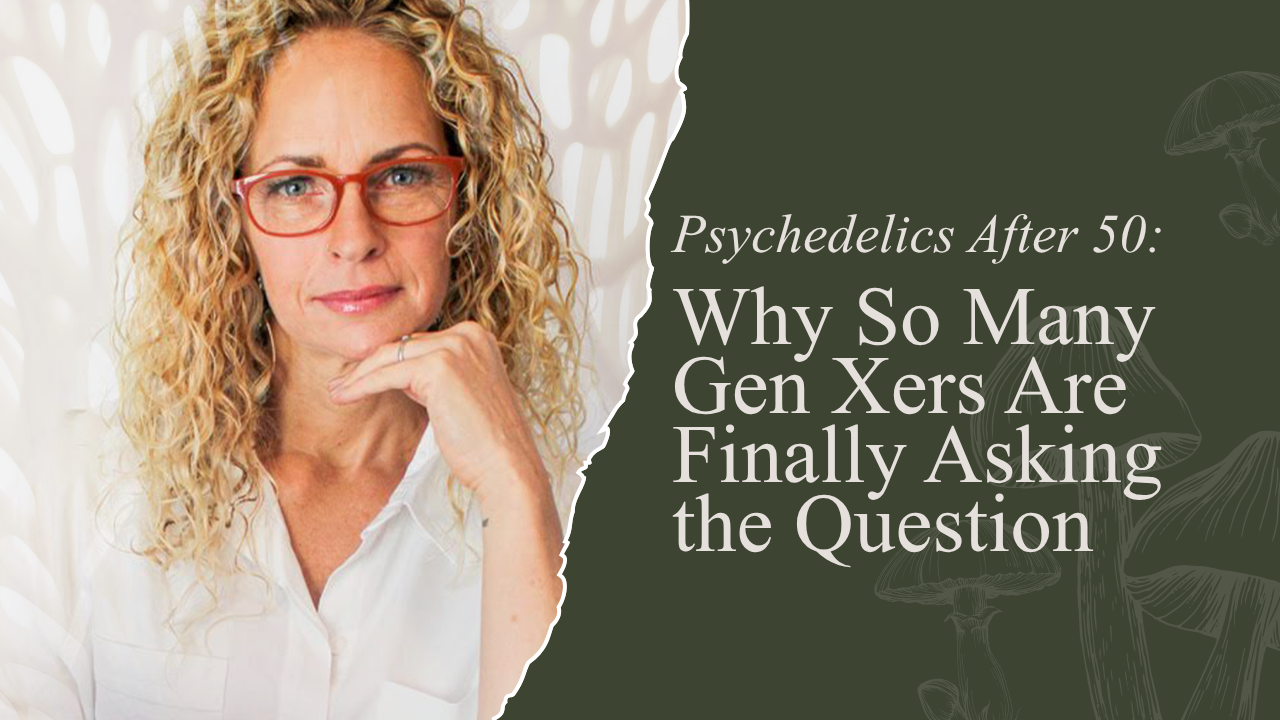
Psychedelics After 50: Why So Many Gen Xers Are Finally Asking the Question
For many people over fifty, curiosity about psychedelics doesn't begin with excitement.
It begins with hesitation.
There is usually a quiet question sitting underneath it all.
"Could this actually help me?"
Almost immediately, another voice follows.
"What if everything I was taught about psychedelics was true?"
If you grew up in the Gen X generation, those fears make sense.
For decades, psychedelics weren't introduced as medicines. They were presented as something dangerous, reckless, and life-altering in the worst possible way. The messaging was simple: stay away.
Those beliefs became deeply embedded, even for people who never had any direct experience themselves.
Now something different is happening.
More adults in their fifties and sixties are beginning to hear conversations about microdosing, psilocybin, and plant medicine from doctors, researchers, podcasts, documentaries, and trusted friends. Instead of dismissing the conversation, they're becoming curious.
Not because they're chasing an experience.
Because they're searching for something that traditional approaches haven't fully provided.
Why Curiosity Often Arrives Later in Life
The second half of life tends to bring different questions.
Children become adults.
Careers begin to change.
Relationships evolve.
Retirement appears on the horizon.
Many people reach a point where they begin asking themselves whether the life they've built still reflects who they truly are.
That moment often creates space for curiosity.
Not curiosity about escaping life.
Curiosity about experiencing it differently.
For many Gen Xers, psychedelics aren't appealing because they're looking for another high.
They're appealing because people are beginning to wonder whether healing is still possible after decades of carrying stress, grief, emotional pressure, and deeply ingrained patterns.
The Fear Was Learned
Much of the fear surrounding psychedelics wasn't built through personal experience.
It was inherited.
Entire generations were taught that substances like psilocybin were inherently dangerous, with little distinction between recreational misuse and intentional therapeutic use.
For many people, those early messages still influence how they respond today.
Even hearing the word "psychedelic" can activate uncertainty.
That doesn't make someone closed-minded.
It simply reflects how powerful early conditioning can be.
The important question isn't whether those fears exist.
It's whether we're willing to become curious enough to examine them.
Microdosing Isn't About Escaping Reality
One of the biggest misconceptions is that people turn toward psychedelics because they want to escape.
For many, the opposite is true.
Some arrive at microdosing after years of trying to numb difficult emotions through work, constant busyness, alcohol, or other coping strategies.
Others come after realizing they've spent decades surviving rather than fully participating in their own lives.
Microdosing often invites something very different.
Presence.
Instead of disconnecting from reality, many people describe becoming more aware of it.
They notice their thoughts more clearly.
They become more aware of their emotional reactions.
They begin paying attention to patterns that have quietly shaped their lives for years.
That awareness isn't always comfortable.
But it often becomes the beginning of meaningful change.
Healing Doesn't Always Begin With Trauma
People often assume that someone explores plant medicine because something dramatic happened.
Sometimes that's true.
Other times, there isn't one defining event.
There is simply a lifetime of accumulated experiences.
Years spent putting everyone else first.
Years spent believing success meant productivity instead of connection.
Years spent measuring self-worth through achievement while quietly ignoring emotional wellbeing.
Over time, those patterns become normal.
Until one day they no longer feel sustainable.
That's when many people begin asking whether there's another way to live.
Not a perfect life.
A more connected one.
Redefining What Strength Looks Like
For many men, especially those raised within traditional expectations of masculinity, emotional vulnerability was never encouraged.
Strength often meant staying composed.
Providing.
Solving problems.
Continuing regardless of what was happening internally.
But emotional suppression carries a cost.
Unprocessed grief doesn't disappear.
Stress doesn't simply dissolve.
Disconnection from ourselves eventually becomes disconnection from the people we love most.
Healing often begins when strength is redefined.
Not as the ability to avoid emotion.
But as the willingness to experience it honestly.
Many people who begin intentional work with plant medicine describe something surprisingly simple.
They feel.
Sometimes for the first time in years.
Not because the medicine creates emotions.
Because it creates enough space to finally acknowledge the ones that have always been there.
Presence Changes Relationships
One of the most powerful shifts people describe isn't something dramatic happening inside themselves.
It's how they begin showing up for others.
Partners feel more heard.
Children feel more seen.
Conversations become less focused on fixing problems and more focused on understanding each other.
Presence cannot be manufactured through effort alone.
It grows through awareness.
When we become more aware of ourselves, we naturally become more available to the people around us.
That may be one of the greatest gifts of healing.
Not becoming someone new.
Becoming fully present with the people who have always mattered most.
Fatherhood Changes When Presence Becomes the Priority
Many fathers spend years believing their primary responsibility is to provide.
To build the career.
Pay the bills.
Create security.
Those things matter.
But many children remember something else.
Whether their parent was truly present.
Being physically there isn't always the same as being emotionally available.
Sometimes the greatest gift a parent can offer isn't another opportunity, another purchase, or another achievement.
It's attention.
It's listening without trying to solve every problem.
It's creating enough emotional safety that a child knows they can bring every version of themselves home.
For many people exploring personal growth later in life, this realization becomes one of the most meaningful shifts.
The legacy they want to leave isn't financial.
It's relational.
Seeing Someone Is Different Than Loving Them
One of the most powerful ideas explored in this conversation is the difference between loving someone and truly seeing them.
Most people would say they love their partner.
They love their children.
They love their family.
But being seen asks something deeper.
It asks whether we understand who the other person actually is, rather than who we expect them to become.
Can we notice when they're struggling without immediately trying to fix them?
Can we make space for their emotions instead of becoming uncomfortable with them?
Can we recognize their strengths without placing our own expectations on top of them?
When people begin doing deeper internal work, many discover they haven't simply become more compassionate toward themselves.
They've become more attentive toward everyone around them.
That shift changes relationships in ways that no amount of advice ever could.
Healing Often Begins With Forgiveness
Many people begin exploring healing believing they need to become someone entirely different.
Often, they simply need to let something go.
Old resentment.
Old shame.
Old identities.
Sometimes forgiveness is directed toward another person.
Sometimes it's directed toward ourselves.
Many people carry decades of guilt for choices they made while doing the best they could with the awareness they had at the time.
Holding onto that guilt doesn't protect anyone.
It simply keeps the nervous system connected to the past.
Healing doesn't require pretending difficult experiences never happened.
It asks whether we're ready to stop allowing them to define every step forward.
Love.
Forgive.
Move forward.
Simple words.
Lifelong practice.
Microdosing Doesn't Do the Work For You
One of the most important reminders in this conversation is that plant medicine isn't a shortcut.
It isn't a replacement for personal responsibility.
It doesn't remove the need for honest conversations, healthy relationships, emotional regulation, or meaningful integration.
Instead, it can create conditions where those things become easier to access.
Awareness increases.
Patterns become visible.
Emotions become clearer.
But awareness alone isn't transformation.
What matters is what happens afterward.
The conversations you choose to have.
The habits you begin changing.
The relationships you decide to repair.
The boundaries you finally set.
The medicine may open the door.
Walking through it remains your responsibility.
It's Never Too Late to Become Curious
One of the most encouraging parts of this conversation is that healing isn't reserved for one stage of life.
Many people assume they've waited too long.
That their habits are fixed.
Their relationships are permanent.
Their emotional patterns are simply who they are.
But curiosity has no age limit.
Whether someone is forty, fifty, sixty, or beyond, the capacity to learn, reflect, reconnect, and grow remains available.
Growth rarely happens all at once.
More often, it begins with one honest question.
"What if there is another way?"
For many people, that question becomes the beginning of an entirely different relationship with themselves.
Key Takeaway
For many Gen Xers, curiosity around psychedelics isn't about chasing extraordinary experiences.
It's about finally asking whether life can feel different after years of carrying responsibility, stress, emotional conditioning, and expectations that no longer fit.
Microdosing and other forms of intentional plant medicine aren't about escaping reality.
They're invitations to become more present within it.
When approached with education, respect, clear intention, and proper integration, they can create opportunities to reconnect with yourself, your relationships, and the life you're still creating.
The most meaningful transformation rarely begins with the medicine itself.
It begins the moment you're willing to become curious enough to question what you've always believed.
GET THE FREE WORKSHOP
Trauma, the Body, and the Breath
A free on-demand workshop on releasing what the mind can’t, and how psilocybin supports healing through neuroscience, breathwork, and plant medicine
DON'T MISS WHAT'S NEXT
You don’t have to go looking for the next conversation. New episodes and reflections are shared as they unfold.
Stay connected as they’re released.
We hate SPAM. We will never sell your information, for any reason.